What Is the Standard Size Envelope? (And Why It Matters More Than You Think)
If you’ve ever paused before sealing a mailer, wondering whether your envelope is the right size — you’re not overthinking it. Envelope sizing directly affects postage costs, mail processing speed, and whether your piece arrives at all.
So, what is the standard size envelope in the United States? The short answer: it’s the #10 envelope, measuring 4.125 × 9.5 inches (104.8 × 241.3 mm). It’s the backbone of business mailing — and for good reason.
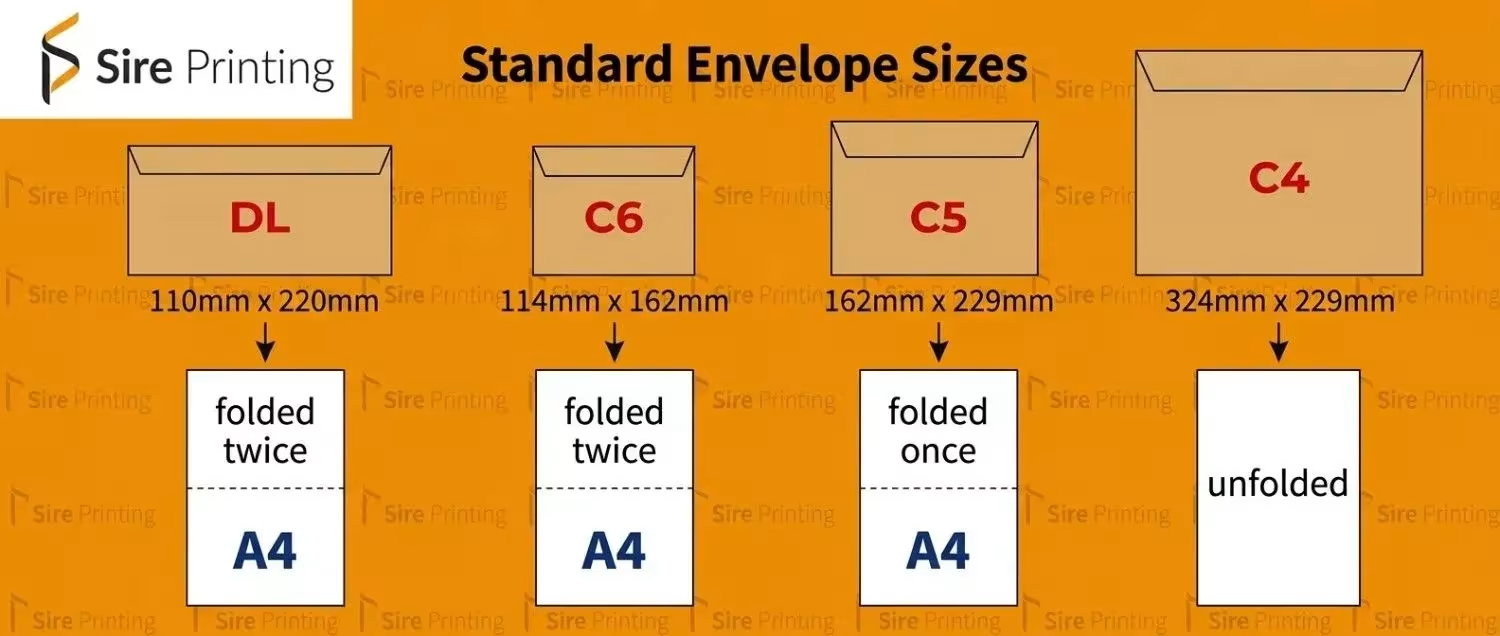
Internationally, the equivalent is the DL envelope (110 × 220 mm), governed by ISO 216 — the global paper and envelope sizing standard. If your business mails across borders, both matter.
The Standard Envelope Size, Explained
The #10 is so dominant in American offices that “standard business envelope” and “#10 envelope” are used interchangeably — and with good reason.
Its dimensions weren’t chosen arbitrarily. A standard 8.5 × 11 inch letter, folded neatly into thirds, slides into a #10 envelope with room to spare. That simple relationship between paper and envelope is why it became the default for invoices, cover letters, bank statements, and direct mail campaigns across the country.
The USPS Domestic Mail Manual (DMM) — the actual governing document for US mail — recognizes the #10 as the industry’s baseline. Postal systems are built around processing it efficiently. Deviate too far, and you pay for it — literally.
Full Standard Envelope Size Chart
Here’s a comprehensive envelope size chart covering every major category you’ll encounter — from everyday correspondence to catalog mailers.
|
|
|
|
|
|
|
|
|
|
|
|
|
|
|
|
|
|
|
|
|
|
|
|
|
|
|
|
|
|
|
|
|
|
|
|
|
|
|
|
|
|
|
|
|
|
|
|
|
|
|
|
|
|
|
|
|
|
|
|
|
|
|
|
|
Pro tip: Standard envelope dimensions determine your postage class before anything else. Always verify dimensions before placing a print order.
USPS Mail Classes — Letter vs. Large Envelope vs. Parcel
The USPS doesn’t see all envelopes equally. It classifies mailpieces into distinct categories, and the size of your envelope determines which class it falls into — which directly affects cost and delivery timeline.
Here’s how the USPS Domestic Mail Manual breaks it down:
Letters must fall within these thresholds:
- Minimum: 3.5 × 5 inches
- Maximum: 6.125 × 11.5 inches, up to 0.25 inches thick
- Weight limit: up to 3.5 oz at letter rate
Large Envelopes (Flats) cover a wider range:
- Minimum: one dimension exceeds the letter maximum
- Maximum: 12 × 15 inches, up to 0.75 inches thick
Parcels kick in once your envelope exceeds flat dimensions or weight limits.
Your #10 envelope? Comfortably in the letter class. A 9 × 12 catalog envelope? That’s a large envelope or “flat” — a different pricing tier entirely. Understanding this classification before you design or order saves you from budget surprises at the post office.
How Envelope Size Affects Postage Cost
Size and weight are the two levers that control what you pay to mail anything in the US. Here’s how they interact — and where most people get caught off guard.
Letter rate applies to envelopes within the letter class limits. As of USPS current pricing, a standard one-ounce letter uses a single Forever Stamp.
Each additional ounce requires an additional-ounce stamp. Once you exceed 3.5 ounces, the piece reclassifies as a flat — at a higher rate.
Flat rate (large envelope postage) is meaningfully more expensive per piece — which adds up fast on high-volume campaigns.
The Non-Machinable Surcharge — A Hidden Cost Most People Miss

Here’s something that surprises a lot of businesses: square envelopes cost more to mail. The USPS applies a non-machinable surcharge to any piece that can’t be processed by automated mail-handling equipment. Square envelopes, unusually thick envelopes, or those with clasps or buttons all trigger this fee.
If you’re planning a square-format invitation mailer or a specialty direct mail campaign, factor this surcharge into your budget from day one. It’s not a penalty — it’s a classification. But it’s one that catches people off guard.
What Happens If You Use a Non-Standard Envelope Size
Choosing an envelope that falls outside standard envelope dimensions isn’t just a postal technicality — it has real operational consequences.
Common outcomes include:
- Postage reclassification — you pay flat or parcel rates even if you budgeted for letter rates
- Processing delays — non-standard pieces often require manual handling, adding transit time
- Returned mail — envelopes that fall below USPS minimums (under 3.5 × 5 inches) cannot be processed and may be returned undelivered
- Damage in transit — odd-sized pieces that don’t sort well through machinery face higher physical damage rates
For businesses running direct mail at volume, these aren’t hypothetical concerns. A misjudged envelope size on a 10,000-piece campaign can mean thousands of dollars in unexpected postage — or pieces that never reach their destination.
International Standard Envelope Sizes — ISO 216 & the DL Envelope

If your audience extends beyond US borders — or if you work with suppliers and partners in Europe or the UK — the phrase “standard size envelope” means something slightly different.
Internationally, envelope sizing is governed by ISO 216, the standard that also defines the familiar A-series paper sizes: A4, A5, A6, A7. The commercial mailing workhorse in most of the world is the DL envelope — 110 × 220 mm, or roughly 4.33 × 8.66 inches.
The DL was specifically designed to hold an A4 sheet folded into thirds — mirroring the same logic behind the #10 and 8.5 × 11 paper in the US. Same functional relationship, different measurement system.
Royal Mail in the UK uses a comparable “large letter” classification, with its own size thresholds distinct from USPS. If you’re shipping branded mailers internationally, knowing both systems protects you from postage surprises on either side of the Atlantic.
How to Choose the Right Envelope Size
Picking the right envelope isn’t complicated once you know what goes inside it. Work backwards from your content.
For standard business letters and invoices:
The #10 standard business envelope is your answer. Fold your 8.5 × 11 document into thirds — it fits perfectly.
For unfolded documents, flyers, or multi-page packets:
A 9 × 12 or 10 × 13 catalog envelope keeps your content flat and professional. Arrives looking polished, not crumpled.
For invitations, greeting cards, and announcements:
Match your card size to an A-series envelope. A 5 × 7 card fits an A7 envelope cleanly. A 4 × 6 card slides into an A6.
For reply envelopes or remittance slips:
The #9 is designed to nest inside a #10. The #6¾ works the same way for smaller return pieces.
For bulk catalogs, sample kits, or larger documents:
A booklet or catalog envelope (6 × 9 or larger) gives your content room to breathe without awkward folding.
One rule that applies universally: when in doubt, go slightly larger. A snug envelope risks tears. A slightly roomier one looks more intentional and professional.
Custom Printed Envelopes — Where Standards Meet Your Brand
Understanding what the standard size envelope is gives you the foundation. What you do with that foundation is where your brand comes in.
Custom printed envelopes are produced to the same standard envelope dimensions outlined in this guide — they’re not a different category. A custom #10 envelope is still a #10. A branded 9 × 12 catalog mailer still qualifies as a large envelope under USPS rules. The difference is what’s printed on it.
At Sire Printing, every custom envelope order is sized against USPS mail class requirements before it goes to press. That means your branded envelopes don’t just look great — they mail correctly, without surprise surcharges or processing delays.
And if your campaign calls for packaging beyond the envelope — think custom mailer boxes for subscription boxes, product kits, or premium unboxing experiences — we handle those too, built to the same exacting standards. For a full view of what’s possible across your packaging program, custom packaging boxes offer a broader starting point.
Final Thoughts
Envelope sizing is one of those details that looks simple on the surface and gets surprisingly consequential the moment you’re managing a real mailing campaign.
From the #10’s relationship with folded letter paper to the USPS’s non-machinable surcharges on square formats, the specifics matter — both for your budget and your brand’s first impression.
The standard size envelope in the US is the #10. Internationally, it’s the DL. But beyond that single answer lies a full system of sizes, classifications, and postal rules that inform every mailing decision you make.
When your envelopes need to do more than just hold paper — when they need to carry your brand, convert recipients into customers, and arrive without a hitch — that’s where thoughtful design and precise sizing work together.
Frequently Asked Questions
What size is a #10 envelope?
A #10 envelope measures 4.125 × 9.5 inches (104.8 × 241.3 mm). It’s the most common business envelope size in the United States, designed to hold a standard 8.5 × 11 letter folded into thirds.
Is a 9 × 12 envelope considered a large envelope?
A 9 × 12 envelope exceeds the USPS maximum dimensions for a letter, so it’s classified as a “flat” or large envelope. This category carries higher postage rates than standard letters.
Do square envelopes cost more to mail?
Square envelopes cannot be processed by USPS automated equipment, so they’re subject to a non-machinable surcharge on top of standard postage. Budget for this before committing to a square format for high-volume mailings.
What’s the difference between a letter and a flat in USPS classification?
A letter fits within 6.125 × 11.5 inches and weighs under 3.5 oz. A flat (large envelope) exceeds at least one letter dimension and can be up to 12 × 15 inches. The distinction affects both pricing and processing speed.
Can a custom-size envelope still qualify for standard letter postage?
A custom envelope can qualify for letter-rate postage as long as it falls within USPS letter class dimensions (3.5–6.125 inches tall, 5–11.5 inches long, up to 0.25 inches thick, under 3.5 oz). Custom printing doesn’t affect mail classification — dimensions do.
Ready to Mail Smarter?
Sire Printing produces custom envelopes and packaging built to USPS standards, so your brand travels confidently — every time.
|
|
|