|
|
The Real Reason Your CBD Products Aren't Making It to Retail Shelves
You've spent months perfecting your formulation. Your product is tested, your brand looks good, and you're confident in the quality. Then a buyer takes one look at your packaging — and passes.
This happens to CBD brands across the United States every single week. Not because the product is bad, but because the packaging fails to meet what retailers, distributors, and compliance officers need to see. The CBD market has matured rapidly, and shelf buyers are no longer just looking for a pretty label. They're looking for packaging that protects them legally, satisfies FDA hemp labeling guidance, and signals to their customers that the brand behind it is credible.
Here's what's actually costing CBD brands their retail opportunities — and exactly how to fix each one.
1. Missing or Incorrect Compliance Information on the Label
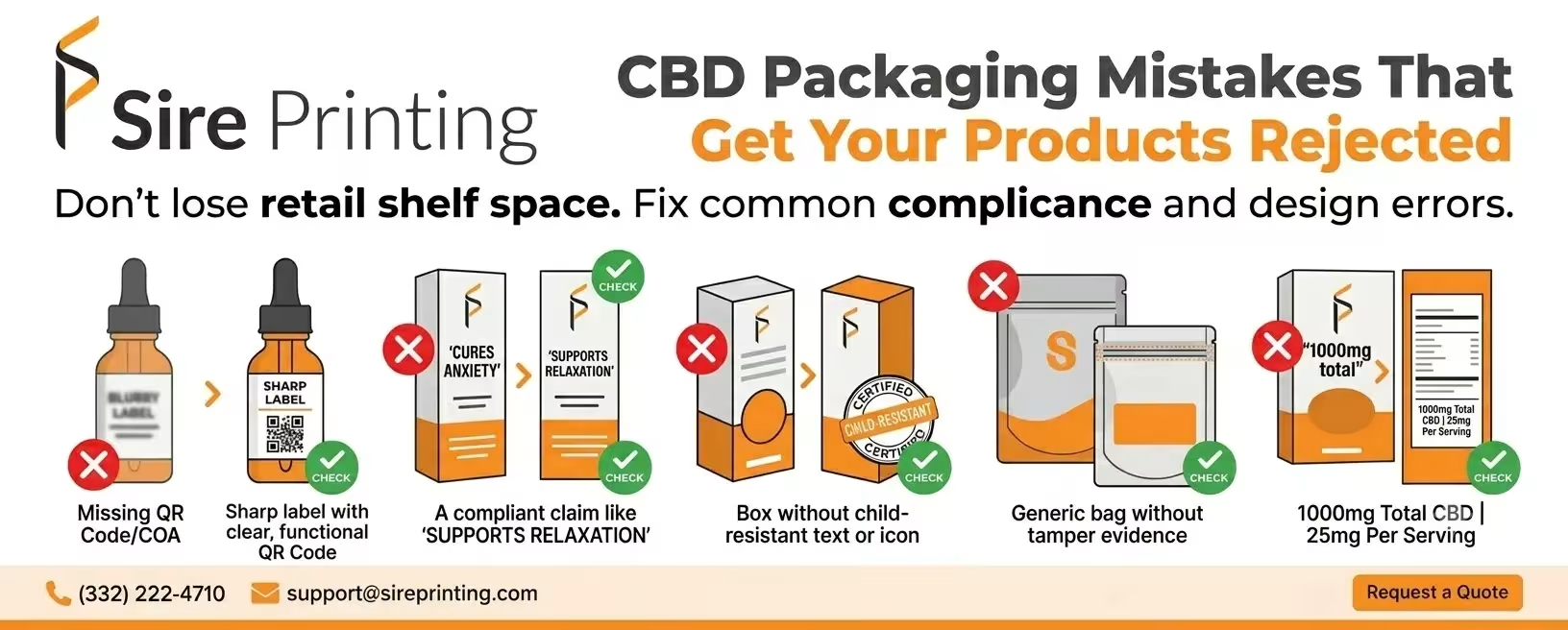
The issue: Many newer CBD brands underestimate just how specific CBD label requirements are under U.S. guidelines. A missing hemp-derived cannabidiol disclaimer, an absent QR code linking to third-party lab results, or a vague ingredient declaration can immediately flag a product as non-compliant in a buyer's checklist.
Retailers that stock CBD products are aware that the FTC and FDA scrutinize unsupported health claims aggressively. If your label says "cures anxiety" or "treats inflammation," most serious retailers won't touch it. The liability isn't worth it to them.
The fix: Your label must clearly state that the product contains hemp-derived CBD, include a certificate of analysis (COA) link or QR code, list all ingredients by their proper INCI names, disclose CBD concentration per serving and per package, and make zero unverified medical claims. If you're working on retail-ready CBD packaging, treat your label as a legal document first and a marketing asset second.
Sire Printing works directly with CBD brands to develop custom CBD packaging that incorporates all necessary compliance elements without sacrificing your visual brand identity.
2. No Child-Resistant Packaging — A Deal-Breaker in Most States
The issue: Child-resistant packaging requirements for CBD products aren't uniform across every state, but many major retailers enforce them company-wide regardless of where a product ships. In states like California, Colorado, and New York, child-resistant closures on cannabis-adjacent products aren't optional — they're mandated. A buyer in a national chain won't carry two separate packaging standards; they need the safer version.
According to poison control data, edible and oil-based products are among the most common accidental ingestion cases involving children. Retailers know this. If your packaging doesn't have a certified CR closure or a resealable CR zipper for pouches and gummies, it signals a gap in your quality control process — not just a packaging oversight.
The fix: Integrate certified child-resistant mechanisms into your packaging from the design stage, not as an afterthought. Sire Printing's child-resistant boxes are specifically designed to meet ASTM D3475 standards and work for oils, tinctures, gummies, capsules, and topicals — while still looking professional on a retail shelf.
3. Packaging That Doesn't Reflect Your Product's Dosage Clearly
The issue: CBD dosage clarity is one of the most commonly cited reasons buyers at health-focused retailers pass on a product. If a shopper has to work to find out how many milligrams are in each serving, the buyer knows they will. Confusing dosage panels erode consumer trust before the first purchase — and retail buyers know this.
Hemp product packaging standards increasingly expect brands to display total CBD per package and per unit with consistency and clarity. When these numbers are buried in fine print or formatted inconsistently, it reads as either amateur or intentionally evasive.
The fix: Use a dedicated dosage panel on your packaging. State total CBD in mg, serving size in mg, and number of servings per container prominently — not as a footnote. This single change can meaningfully improve your retail acceptance rate.
Retail-Ready CBD Packaging Checklist
|
|
|
|
|
|
|
|
|
|
|
|
|
|
|
|
|
|
|
|
|
|
|
|
|
|
|
|
|
|
|
|
|
|
|
|
4. Health Claims That Flag Your Brand as a Legal Risk
The issue:
CBD packaging regulations in the U.S. prohibit disease claims on labeling and advertising. Statements like "relieves chronic pain," "treats depression," or "cures sleep disorders" are hard violations under FTC and FDA guidance. In a 2023 sweep, the FDA sent warning letters to dozens of CBD companies for exactly these types of claims and retailers read those news cycles carefully.
When a buyer at a health food chain or pharmacy sees unsupported therapeutic language on your packaging, they don't just pass on your product. They flag your brand internally as a risk.
The fix: Transition every claim on your packaging to a permissible structure/function format: "Supports healthy sleep" is allowable; "Treats insomnia" is not. Include the required FDA disclaimer for dietary supplements where applicable. Have a compliance attorney or regulatory consultant review your label copy before going to print.
5. Packaging That Doesn't Survive the Supply Chain
The issue: CBD oil boxes, dropper bottles, and specialty formats need to survive transit, warehouse handling, and retail display — sometimes for months. Thin cardboard that dents, labels that peel in humidity, and closures that loosen in shipping are red flags for retail buyers who've dealt with damaged inventory returns.
Hemp product packaging that looks great in a product photo but arrives on a pallet with corner damage or moisture warping can get an entire order rejected before it ever reaches the floor.
The fix: Work with a packaging manufacturer that understands the weight, fill, and handling requirements of CBD products specifically. Sire Printing's CBD oil boxes and CBD dropper boxes are engineered for structural integrity through the full distribution chain, not just shelf presentation.
6. No Tamper-Evidence — A Hard Stop for Many Chains
The issue: Major grocery, pharmacy, and wellness retailers require tamper-evident seals as a baseline. It's not just about theft. Post-pandemic, consumer expectations around product safety have shifted permanently. A product without a visible tamper-evident feature — a shrink band, induction seal, or breakaway closure — looks incomplete to a trained buyer.
The fix: Add a tamper-evident layer to your packaging specification before you approach any retail account. For CBD lollipops and edible formats, this is especially important both for compliance and for consumer confidence. Sire Printing's CBD lollipop boxes include options for sealed, display-ready packaging that checks both the safety and merchandising boxes.
|
|
7. Poor Shelf Presence — When Compliance Is There but the Packaging Still Loses
The issue: Passing a compliance checklist is the floor, not the ceiling. Retail buyers also make decisions based on how a product will perform on a crowded shelf. If your CBD packaging looks generic, dated, or inconsistent with your brand's premium positioning, it's competing poorly against established players who've invested in print quality, structural design, and shelf-differentiated visual identity.
CBD packaging compliance gets you considered. Design quality gets you placed.
The fix: Invest in print finishes, structural packaging, and brand-consistent design that communicates value at a glance. Matte lamination, spot UV, embossing, and foil stamping aren't luxury add-ons in competitive retail — they're the baseline in many wellness categories. Work with a packaging partner who understands both the compliance requirements and the aesthetic demands of the U.S. CBD market.
Frequently Asked Questions
What are the most common CBD packaging requirements for retailers?
Retailers typically require a hemp-derived CBD disclaimer, child-resistant closure, batch/lot number, expiration date, third-party COA access via QR code, milligram disclosure per serving and per package, and no unsupported health claims.
Do all CBD products need child-resistant packaging?
Not every state mandates it for hemp-derived CBD, but most major national and regional retail chains enforce it as company-wide policy. Building it into your packaging from the start is the safest path to retail approval.
What's the difference between a health claim and a structure/function claim?
A health claim links your product to treating, curing, or preventing a disease. A structure/function claim describes the role of a nutrient or ingredient in supporting normal body functions. Only the latter is permissible on CBD labels without FDA drug approval.
How do I know if my CBD label meets current regulations?
Have your label reviewed by a regulatory compliance consultant familiar with the FDA's hemp product guidance and your target states' specific rules. At minimum, cross-reference the FTC's CBD advertising guidelines and your retailer's own vendor compliance documentation.
Can good packaging design actually help me get into retail?
Strong, professional packaging signals to buyers that your brand is established, serious, and ready for retail environments. In a category where trust is still being built with consumers, packaging quality is one of the fastest signals a buyer uses to assess whether to take a meeting at all.
|
|